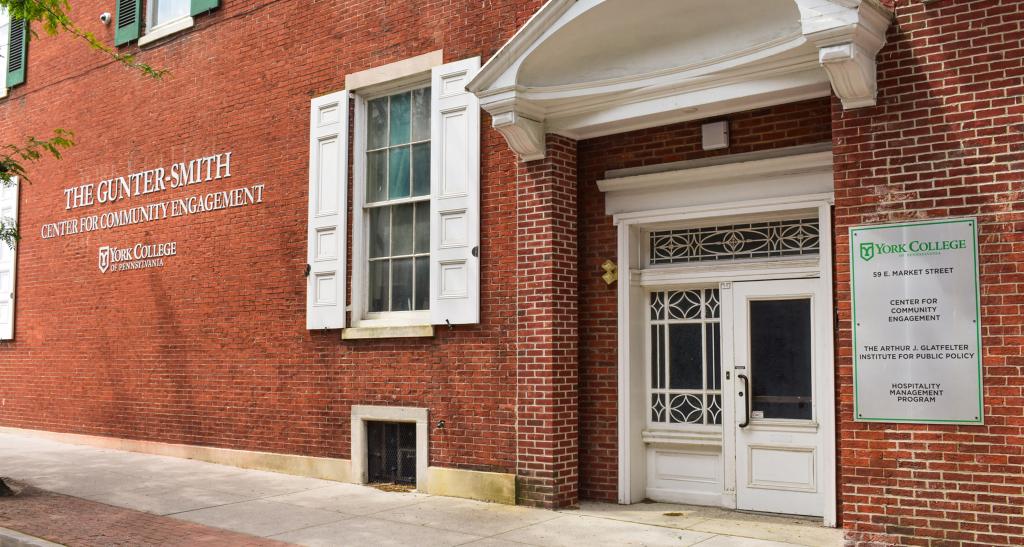

Engage in real-world projects.
Have you ever asked a teacher (or yourself) “how will I use what I am learning in the real world?”
Project- and Community-Based Learning (CBL) can help you answer that question. At York College, you’ll have the opportunity to use what you learn in the classroom to engage in real-world projects with community partners! The old-school model of merely learning facts is not sufficient in today's world. Solving highly complex problems while working on authentic projects in the community will provide students with 21st-century skills.
Working side by side, community members and students seek solutions to current social, business, and government problems. Merging classroom learning outcomes with community interaction allows students to engage in opportunities that make learning more meaningful and more significant.
All of our students have the opportunity to work on real-world projects with community partners in their First-Year Seminar courses through their Capstone Courses. They are guided and mentored by their professors, becoming directors and managers of their learning process.
We know by experience that students are more engaged in their education and retain their learning more fully when they apply classroom learning in real, hands-on environments. And when you’re ready to graduate, you’ll have a wealth of experience to tell prospective employers about — real accomplishments that show not only what you’ve learned, but what you’ve done!
Working together, the Center for Faculty Excellence and the Center for Community Engagement connect classes with community partners in which you can learn by doing as you address their real needs.
Explore Featured Projects
Community-Based Learning at York College
Solving highly complex problems requires not only fundamental academic skills — like reading, writing, and math — but also 21st-century skills such as collaboration, communication, time management, research, information synthesis, problem-solving, and utilizing technology (including video conferencing and virtual collaboration tools). Participating in CBL helps students to hone these skills, which are valuable assets in any career.
CBL activities and projects are defined by several characteristics:
- They originate in real community needs as defined by the partner organization.
- They are founded in careful research and analysis to make data-informed decisions.
- They are propelled by investigation of defined goals.
- They are led by students and mentored by teachers.
- They are significant to the student.
- They consist of a task, a process, and/or a product, as well as the opportunity for reflection on learning.
CBL courses incorporate these characteristics by guiding students to move toward a particular learning goal while addressing a specific need in the community. As part of a CBL course, you will:
- Apply fundamental academic skills and 21st-century skills to address a real-world issue.
- Think critically, ask questions, and practice intelligent listening.
- Cultivate expertise in the subject matter and develop ownership over your innovations.
- Incorporate feedback from both the instructor and your peers as you fine-tune your ideas.
- Publicly present your findings, demonstrate your knowledge, and respond to questions and comments.
Community-Based Learning (CBL), most simply, is real-world learning. Rather than simply being tested on what you know, it helps you test yourself on what you do.
Rather than starting with a list of things to learn, CBL courses begin with a problem to solve, a need to be met, or a project to be completed. This allows students to identify what they need to learn to complete a real project with a community partner and to apply theoretical course content on a deeper, more direct level. It has been proven that CBL promotes not only academic understanding but also organizational and social understanding and the ability to work in teams — key skills employers look for as they hire and make decisions about promotion and advancement. CBL creates a three-fold benefit: engaged teaching, engaged students, and an engaged public.
As a student, CBL gives you the opportunity to:
- Build a network of relationships.
- Engage directly with community partners.
- Gain experience working in a professional setting.
- Develop social and cultural awareness.
- Hone communication and interpersonal skills.
- Practice critical thinking, reasoning, and decision-making.
- Utilize creative and innovative strategies.
- Identify and select the appropriate tool for the task.
- Collaborate with community partners and the public to address challenges.
- Develop a sense of personal and civic responsibility.
- Gain self-actualization and develop self-worth.
To learn more about Community- and Project-Based Learning, visit these sites:
Successful community-based learning initiatives depend on equal partnerships with area agencies and institutions. We begin by asking our partners what needs they have, and then we try to match the community partner with the students and faculty who are best equipped to help to serve those needs.
The Center for Community Engagement partners with a variety of local organizations, offering many possibilities for CBL.
Engagement with civic organizations: The York region shares many of the same challenges experienced by similar-sized towns and cities across the nation. These challenges include issues related to food insecurities, veterans’ rights, educational needs, economic development, and more. Many local human service agencies welcome input from our students and faculty who help to address these challenges through CBL.
Engagement with local companies: Combining the intellectual capital and research facilities of York College with the expertise of local business and organization leaders can provide mutual benefit. This can include projects in research and development, logistics, marketing, and design.
Engagement with government: The Center for Community Engagement and the Arthur J. Glatfelter Institute for Public Policy work with local, county, and state government officials on solving a wide array of real-world problems.
Engagement with the cultural community: The Center for Community Engagement operates its own cultural center, Marketview Arts, and also partners with cultural organizations such as the Cultural Alliance of York County, Creative York, and the Appell Center for the Performing Arts. CBL courses in the arts can give students the chance to make a real impact and to gain experience in arts management, planning events, and developing showcases.
GET INVOLVED:
Building a strong partnership for community-based learning takes a bit of time—but is well worth it! We suggest that community members interested in developing a community-based learning project or course contact us as soon as possible. Generally speaking, it is best to talk with us before early-to-mid-November for spring or summer courses, and by early-to-mid-May for fall courses. Of course, we're ALWAYS glad to speak with you at any time!
Can CBL be done remotely? Yes! Zoom and other communication channels make it not only possible to work remotely, but often more convenient. Many community partners actually find it easier to meet with faculty and students through teleconferences, which increases the frequency of communication and enhances the project.
The Center for Community Engagement (CCE) at York College of Pennsylvania invites faculty to submit proposals for funding to support Community-Based Learning (CBL) projects. This initiative is designed to strengthen academic-community partnerships, enhance student learning, and address community-identified needs. CCE-supported projects should integrate community engagement into course curriculum and learning outcomes, providing students with meaningful, real-world experiences while benefiting local partners.
Please review the criteria and submit your proposal using the form below
Community-Based Learning Project Library
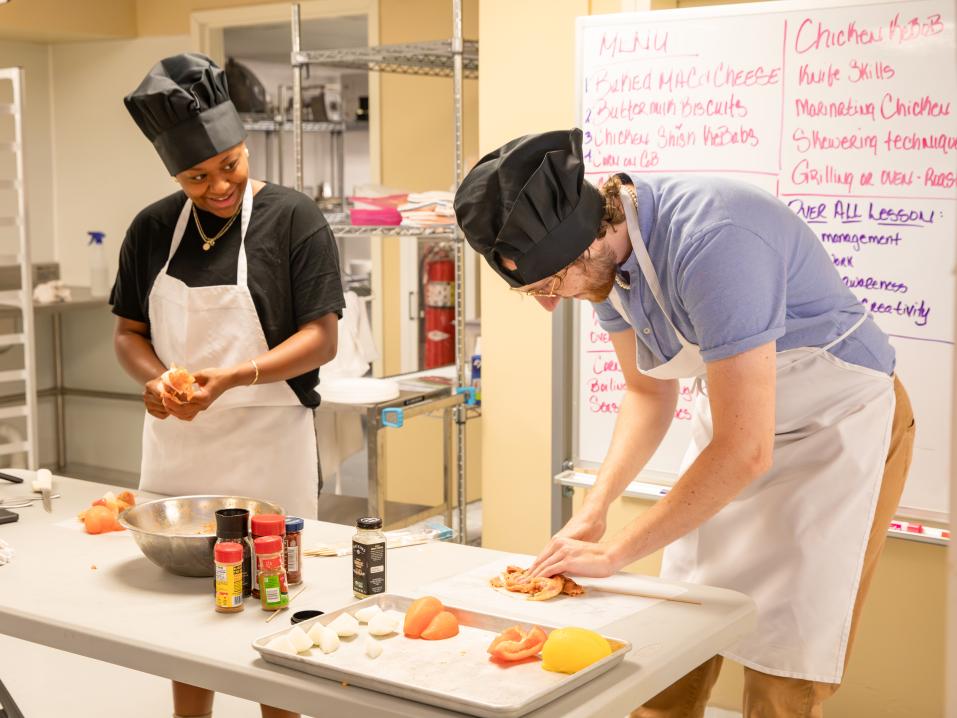
Morales Kitchen, a local nonprofit focused on youth development through culinary arts, worked with students in SPM 230: Concepts of Social Media Platforms at York College of Pennsylvania to develop a social media campaign tailored to their community.
Students created TikTok videos to connect with local youth, LinkedIn posts to reach potential funders and business partners, Facebook content for parents and families promoting events like the Belonging Banquet, and Instagram visuals to strengthen the organization's brand. Along the way, students researched target audiences, managed timelines, and made sure each piece of content reflected Morales Kitchen's goals around youth recruitment, family engagement, and community support.
Organizations interested in a similar partnership can connect with York College's Center for Community Engagement to learn more about getting involved in an upcoming semester.
First-year commuter students at York College partnered with the Cultural Alliance of York through FYS 100: Belonging Blueprints, Commuter Edition to explore what it means to feel connected, valued, and part of a community.
Working alongside a community artist, students used photography to examine themes of belonging and leadership. Their work culminated in a public exhibition at Marketview Arts during a First Friday celebration, where students engaged community members in conversations about how a sense of belonging shapes the path to becoming an effective leader.
Artists interested in exploring a similar collaboration can contact York College's Center for Community Engagement to find out how to get involved.
Students from various majors worked collaboratively to conduct place-based research in downtown York as part of the York County Economic Alliance’s work to resurrect the Zion Lutheran Church’s historical York City building. Students explored the legacy of Zion Lutheran Church and the broader theme of building community through three lenses: history, church design, and the individuals and groups who have been influential throughout its history. Each section of the exhibit, which was displayed at Marketview arts and will eventually live in the restored church building, examines the church’s impact on the community, including its long historical timeline, its notable figures and parishioners, and its architectural evolution
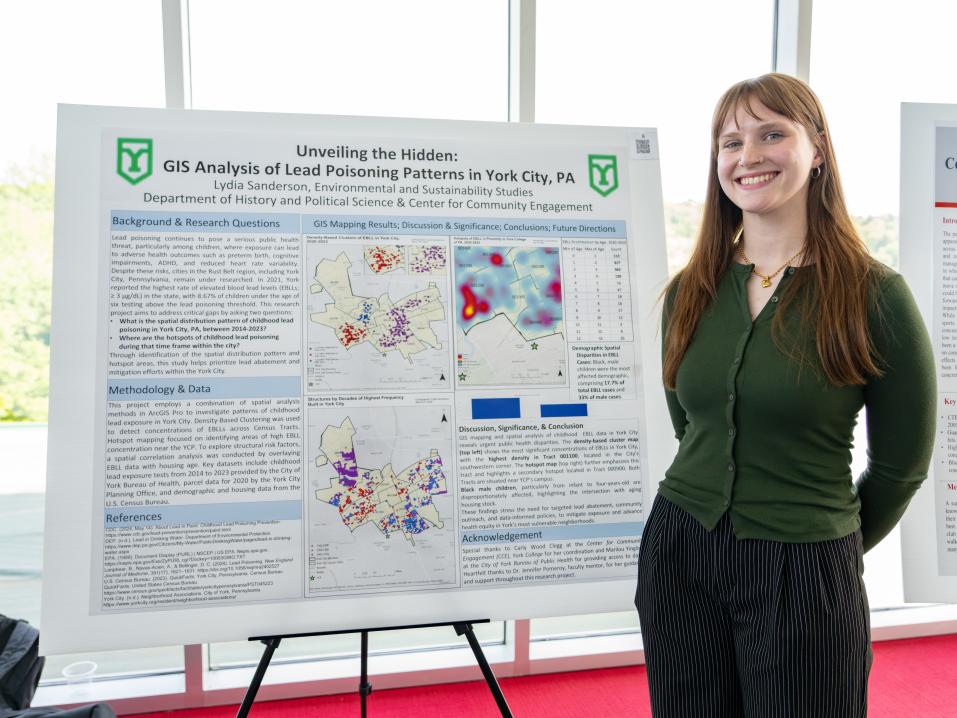
Students worked with various organizations in York to use statistical analyses to address an existing challenge (e.g., volunteer retention, fundraising efficiency, program impact) identified by those organizations. They analyzed existing primary data related to their assigned organization and proposed practical, evidence-based solutions during a poster presentation at the Gunter-Smith Center with partnering organizations.
This project engages students in a real-world HR consultancy scenario. Partnering with Four Squares Construction in Spring 2025 and Friends and Neighbors of PA in Spring 2026, students analyze complex HR challenges faced by the organizations. Past focal areas have included hiring, onboarding, volunteer management, and workplace culture. Guided by their instructor and direct feedback from clients, students develop tailored solutions that closely align with each organization’s mission.
While program evaluation is a crucial endeavor for any organization, it is often incredibly time-consuming. Robust evaluation strategies help community organizations refine their services, articulate their impact, and establish clear goals for the future. This work is more essential than ever as funding streams narrow across the nonprofit sector. Through this project, students amplify community voices by using interviews, surveys, and focus groups to gather insights on program delivery. Student research teams then compile a comprehensive evaluation report and presentation, linking their findings to actionable strategies that address goals identified by the partnering organizations. This real-time feedback is invaluable for resource-constrained organizations striving to meet growing community needs. Past partners include the Center for Community Engagement’s “Fueling for Success” program and Connect York.
Grounded in the “3 C’s” of marketing (Company, Customer, and Collaborators), this course allows students to collaborate with faculty and business partners on a real-world consulting project. To support the client's goals, students navigate a rigorous consulting process: defining the business problem, gathering data, developing tailored solutions, and presenting final recommendations. Additionally, students master the art of data storytelling, learning to synthesize complex information into logical, impactful written reports and in-person presentations. Because deliverables are customized to meet the unique needs of each partnering organization, final projects vary. Past deliverables have included strategic marketing campaigns, gap analyses, and competitive market assessments of similar programs.
This project supports both the fundraising and awareness-raising efforts of York County Libraries (YCL) as they educate the community across five core areas: basic language, information, financial, health, and civic/social literacy. Working in groups, these first-year students create multimodal projects that integrate written, auditory, and visual communication skills. Student teams then pitch their proposed contributions for the Literacy for Change initiative to YCL representatives and other community stakeholders, aiming to deliver a product immediately usable in YCL’s campaign. By engaging students during their first year, this project fosters long-term opportunities for continued involvement with Martin Library as they develop and refine the ideas sparked in this course.
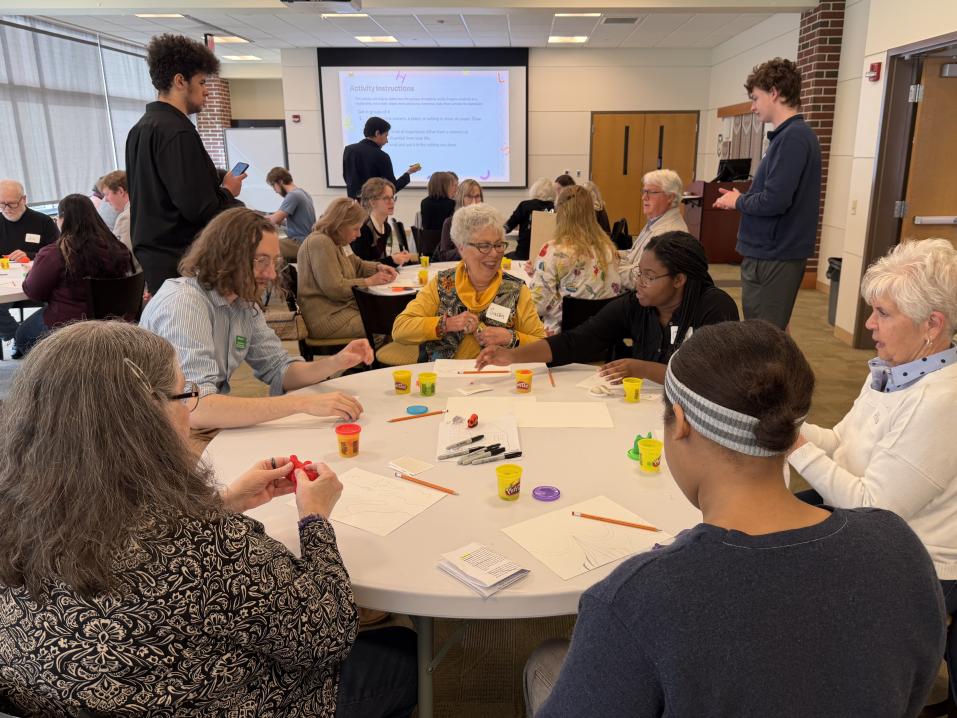
Students interviewed local community leaders to understand York’s most pressing challenges. They discussed the city’s needs, asking for stories, testimonials, and data points that shed light on these challenges. Following the interviews, students worked in teams to brainstorm solutions to these local challenges and create persuasive pitches to share with local stakeholders at a round-table style discussion held at the Gunter-Smith Center. Students’ goal was to spotlight solutions to support the work of local community leaders by applying the principles of persuasion they learned over the semester.
In Fall 2025, students in THE291:101: Script Analysis & Dramaturgy researched the historical and contemporary context of plays to provide resources for the actors, directors, producers, and audience members for two local theater productions: Murder on the Orient Express produced by DreamWrights Center for Community Arts, and Little Shop of Horrors produced by York Academy Regional Charter School and Weary Arts Group. Dramaturgical materials aid directors and designers in refining their production concept, help actors develop their character and interpret the text, and enrich the audience experience through additional context and opportunities for deeper engagement with the play. Guided by the question “Why This Play Now?”, dramaturgs inspire the community to draw connections, discuss, and reflect on important contemporary questions and societal issues.
Center for Community Engagement Staff
View All Staff