A 10-day, four-country trip gave York College of Pennsylvania students a firsthand look at the international partnerships, military command structures, and institutions that shape global security.
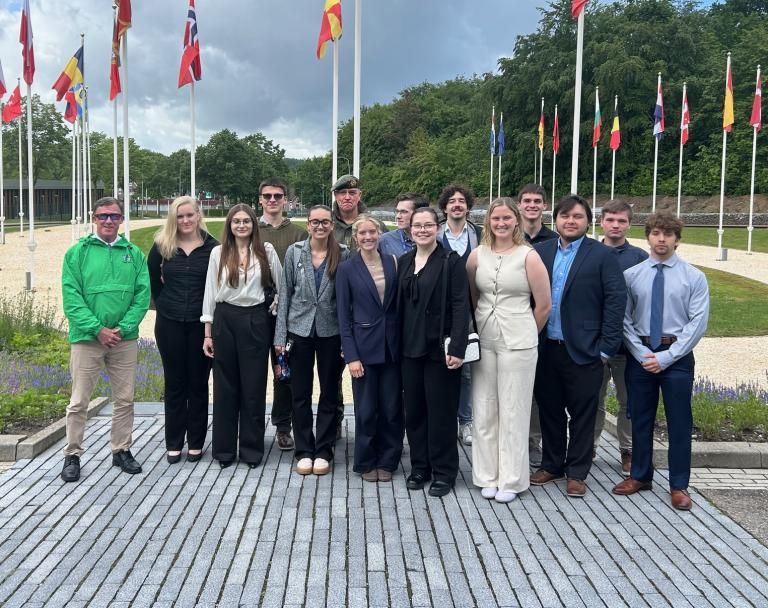
In May, York College of Pennsylvania students traced the path of international cooperation across four European countries, traveling from NATO headquarters to military command centers to the European Parliament. Over 10 days, they visited Belgium, the Netherlands, Germany, and France while exploring the international institutions and partnerships they had spent the semester studying in class.
Connecting classroom learning to global institutions
John Weaver, Professor of Intelligence Analysis who holds a Doctor of Public Administration degree, led the study-abroad experience, which was part of his “NATO Contemporary Security Issues” course. Most of the participating students were Intelligence Analysis majors, though the group included majors in Criminology and Criminal Justice, Marketing, and Engineering.
Before joining York College, Dr. Weaver spent six years working with NATO while serving in the Army. That experience shaped his view of the importance of international partnerships. He learned how multilateralism and working with partners to leverage understanding of threats help the U.S. become a stronger nation.
“Collaboratively, we are better than working independently,” he says.
The trip built on his experience and on the work students completed throughout the semester. In class, through case studies and research on NATO’s headquarters and missions, they examined the role of the 32-nation alliance that discusses and makes decisions on political and security issues.
Their research also led to an opportunity that went far beyond a typical undergraduate course assignment. Students contributed chapters to a peer-reviewed book, “NATO Today: Selected Case Studies,” which is under contract with Nova Science Publishers and expected to be released in November.
“Students can say, ‘I’m published in a peer-reviewed publication.’ No other undergraduate college in the world is doing this to the level that we are,” Dr. Weaver says.
Seeing the subjects of their research up close
The trip itinerary, which aligned with the publication's topics, was designed to help students understand NATO and European institutions from multiple angles. After arriving in Brussels, where NATO is headquartered, on May 17, students took part in historical walking tours and cultural programs before visiting the Council of the European Union and the Parlamentarium. From there, the group visited Supreme Headquarters Allied Powers Europe, NATO’s Allied Command Operations headquarters, also in Belgium.
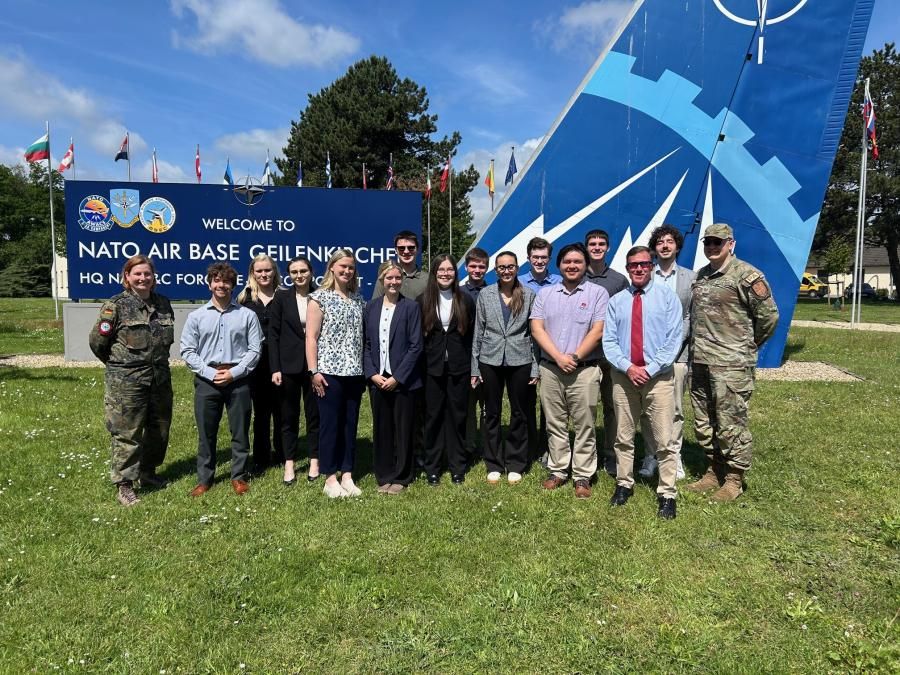
The group then traveled by bus to the Netherlands, where it toured the headquarters of the Allied Joint Force Command in Brunssum. The students next stopped in Germany to visit NATO’s Airborne Warning and Control System (AWACS) at NATO Air Base Geilenkirchen. The trip also included a visit to the European Parliament, the legislative assembly of the European Union, in Strasbourg, France, before a return to Brussels.
For Caitlin Craig ’27, an Intelligence Analysis major with minors in International Relations and Criminology and Criminal Justice, the chance to connect research with real-world experience was especially meaningful.
“My chapter, written along with two of my fellow classmates, Elizabeth Fignar and Kate Egan, is on Allied Joint Force Command Brunssum,” she says. “After getting to do the research and putting together everything for our chapter, it’s very exciting to actually get to put that research to use and visit.”
‘A team sport’
Zak Razo ’26, a Criminology and Criminal Justice major with a minor in Intelligence Analysis, says the trip was relevant to issues in his primary field of study.
“I believe for my major in Criminal Justice, this experience helps a lot,” Razo says, “as some of the major issues in the Criminology and Criminal Justice field deal with terrorism, human trafficking, and organized crime as an enterprise that happens across borders, resulting in having international cooperation to solve these pressing issues.”
Dr. Weaver wants students to see how intelligence analysis, defense, diplomacy, and international cooperation intersect in global institutions that make decisions that affect world security.
The trip reflects Dr. Weaver’s broader teaching philosophy, which he describes as having students create “papers with a purpose.” In his upper-level courses, he looks for ways for students to produce work that extends beyond the classroom, whether through professional presentations, publication opportunities, or research that can help them distinguish themselves as they apply for internships, graduate school, and careers.
“I just hope that they take away that living on this planet is a team sport,” Dr. Weaver says.