York College of Pennsylvania was one of only 20 colleges and universities selected to have a team participate in the 2025-26 Design-Build-Vertical Flight Competition sponsored by the Vertical Flight Society in Churchville, Maryland.
Months of work went into the Spartan Skyforce team’s design and construction of the electric vertical takeoff and landing aircraft, tailored for wildfire emergency response, that the team flew at the April 7-10 event.
For the College’s Engineering Department, the opportunity has been about more than just performance at the competition. The main focus was on demonstrating what students can achieve with a hands-on education.
“It’s always important to put our students out there competing with bigger universities,” says Yargo Teixeira Gomes de Melo, Ph.D., Assistant Professor of Mechanical Engineering. “Other universities have more resources, but our students are very hands-on in their style of learning. In competitions like this, I think our students can even have an edge compared to other colleges.”
Designing for an actual mission
Each year, the competition presents a new challenge. This year’s topic was wildfire response. Teams designed an unmanned aircraft capable of completing complex missions such as transporting and deploying payloads, represented by sandbags. The aircraft had to complete the mission while being remotely piloted and as an autonomous vehicle. For the Spartan Skyforce team, that meant balancing competing engineering priorities.
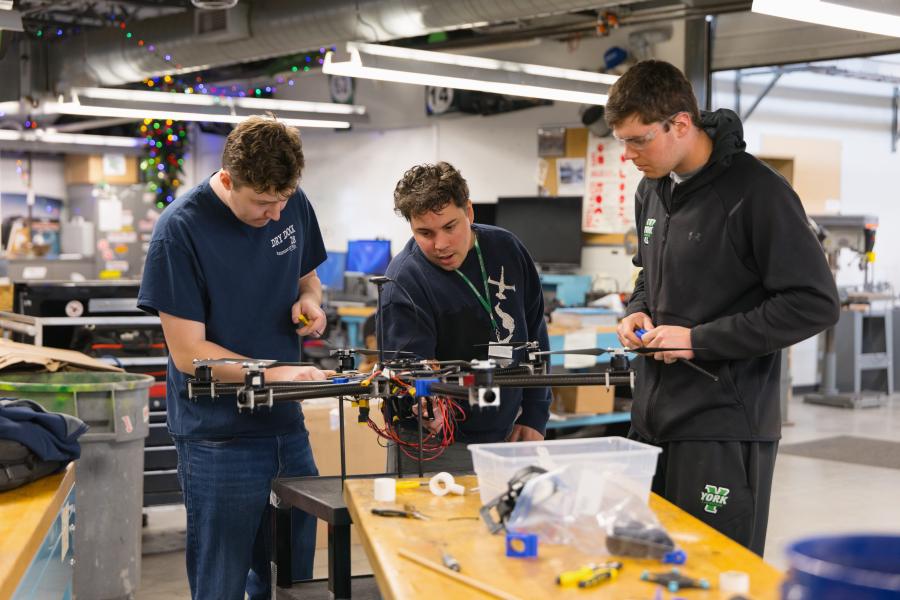
“The drone will fly, and when you fly, you want to be as light as possible. But it needs to carry the weight of the drone and the payload,” Dr. Teixeira Gomes de Melo says. “It’s quite the engineering challenge, trying to diminish the weight while increasing the thrust.”
To meet those demands, the team made a key design decision. Instead of using a four-motor quadcopter, it designed a hex drone with six motors. While that design added power and thrust, it also increased complexity.
A fully integrated engineering effort
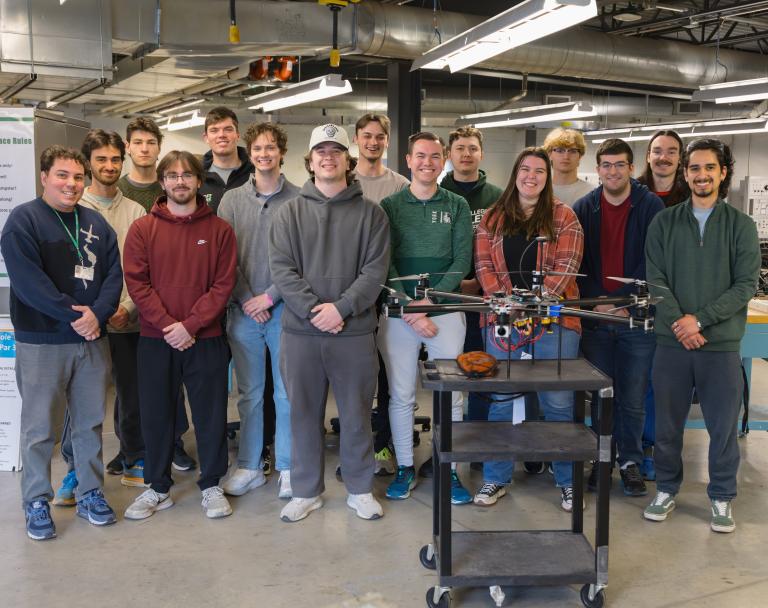
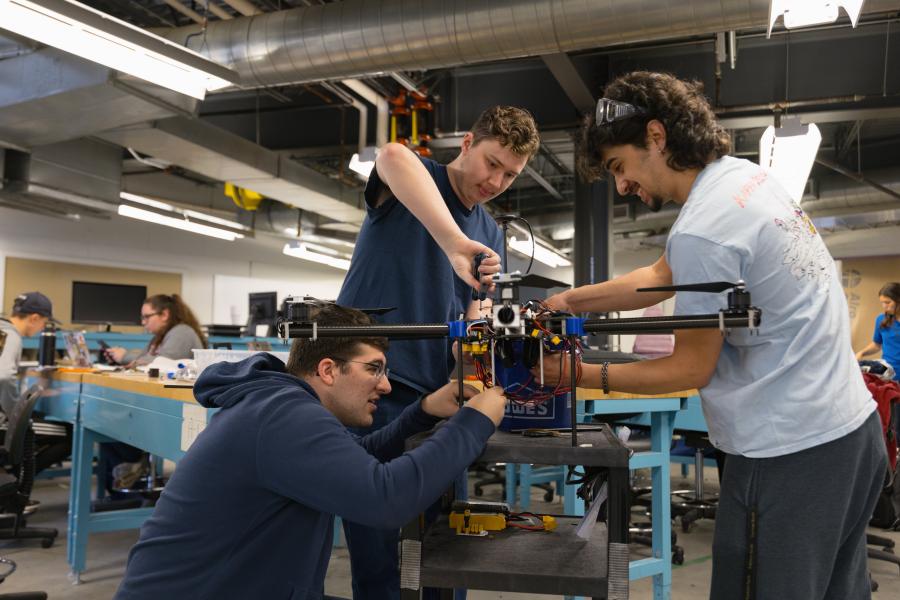
The Spartan Skyforce team comprised 15 students, all seniors, completing their capstone projects in Electrical or Mechanical Engineering. They worked in coordinated subgroups to bring the project to life. This interdisciplinary approach allowed students to experience what a real-world engineering environment might look like.
“Teamwork is a huge part of the project because we have 15 students working together, lots of times working on separate parts of the drone, and we have to make sure it can all be put together,” Dr. Teixeira Gomes de Melo says.
Electrical Engineering students focused on control systems, sensors, and autonomous functionality, while Mechanical Engineering majors designed the frame, aerodynamics, and propulsion systems. They also used artificial intelligence to help the drone find the correct target during autonomous flight.
Learning beyond the classroom
For many of the students, the project represented their first experience applying classroom knowledge to a large-scale, realistic challenge. Thomas Lundy ’26, an Electrical Engineering major, served as the vice-captain and one of the six team members who attended the competition. He was also the flight control team lead, which is the electrical brain of the drone.
“When I was growing up, I saw drones becoming popular for media capture and wondered how they were made and what other applications they could be used for,” Lundy says. “When I saw there was a drone capstone at York College for engineering, I saw it as my chance to grasp what I didn't understand when I was younger and find a new application for drones, such as what we are designing for in this competition, which is fighting wildfires.”
Caroline McCadden ’26, a Mechanical Engineering major, joined the team to expand her understanding of robotic aircraft.
“I really wanted to learn more about drones and thought this would be a great opportunity to do so,” she says.
As part of the aerodynamics and propulsion design team, she worked on technical and operational aspects of the project. She also helped out in other ways where needed, including serving as the team’s treasurer, reaching out to potential sponsors, and overseeing the team’s Instagram page.
Kyan Kraynack ’26, also a Mechanical Engineering major, served as a secondary member in the Propulsion/Aero and the Drop Mechanism teams, responsible for motor selection and payload design, respectively. He was also the team’s Safety Officer, where it was his responsibility to ensure the safe operation of test flights, as the drone is large enough to pose a very serious threat if operated incorrectly.
“Getting to see our team come together over the last couple of weeks and form a real, coherent group has been one of my favorite experiences in my college career,” he says.
‘Punching above our weight’
After months of research, design, and testing, the team got to see its work take flight in early April.
“I’m really proud of the team as a whole and how far we’ve come since our first day in class,” Caroline says. “Most of us went from not knowing too much about drones to designing and manufacturing this drone.”
For Dr. Teixeira Gomes de Melo, the competition reflects the strength of York College’s Engineering program.
“If you love to build things or to take things apart and learn how they work, our Engineering program is where you want to be,” he says. “We take a hands-on approach, and we like punching above our weight.”
More than a competition
At the competition, the Spartan Skyforce team placed 10th overall. York College faculty members said it’s the best they’ve ever seen the team. Georgia Institute of Technology took first place.
While the team focused on performing well at the event, the students experienced the real value of the project before the competition.
“The main takeaway is the process itself,” Dr. Teixeira Gomes de Melo says. “The process of engineering design is what they have learned. Winning is rewarding, but it’s not the end goal.”
Class of ’26 Spartan Skyforce students, for whom the competition was a capstone project
Jacob Jones
Juan Luis Martinez Sabag
Brendan Donahue
Caroline McCadden
Edwin Niemandt
Luke Hodges
Ryan Hornung
Thomas Lundy
Eli Unger
James Sutherland
Kyan Kraynack
Joshua Kirsch
Chris Pappas
Ryan Danielson
Six team members competed at the event
Brendan Donahue (Team Captain)
Thomas Lundy (Co-captain)
Joshua Kirsch (RPIC)
Jacob Jones
Kyan Kraynack (Safety Officer)
Edwin Nienmandt