Over two semesters, a group of Biology and science-related majors completed research in one of three Biology subcategories. In April 2026, they came together to present their findings and share the research skills they had developed.
In BIO 392 Biology Inquiry I: Genes to Ecosystems and BIO 393 Biology Inquiry 2: Genes to Ecosystems, students are given hands-on experience in how to ask complex questions and conduct in-depth research. It allows students to develop skills in a highly supportive environment that they can take into future research opportunities, both with faculty in their senior year and other professionals in their respective fields.
“One aspect of the course that is important to emphasize is that the Biology Inquiry courses are team-taught,” said Dr. Jessica Nolan, Associate Professor of Biology. “Although I coordinate the courses, all of the tenure-track Biology faculty participate in one of the three research groups. So, the experience is definitely a department-wide collaboration and one of the key features of the Biology program.”
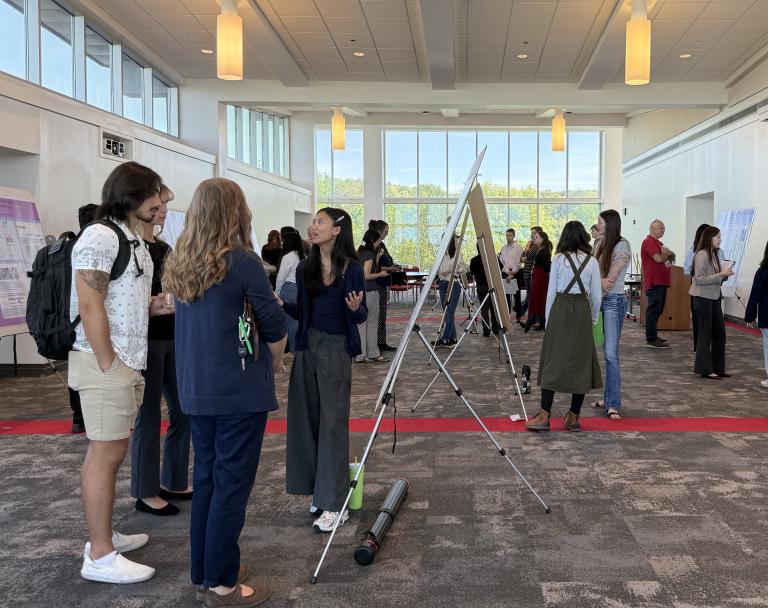
On April 27, 2026, the 18 students in the 2025-2026 cohort held a poster session, taking turns sharing what they discovered and asking each other questions about their respective research. It was also a chance for members of the York College of Pennsylvania community to engage with the students and celebrate what they had accomplished over the course of the academic year.
Exploring the Many Facets of Biology
At the beginning of the year, Biology Inquiry students were divided into three research topic groups chosen by Dr. Nolan and the other professors overseeing the class. While they would all share the same starting point and basis for their research, each student would focus on a specific element that would guide their individual project.
“The three topics we chose reflect a range of subfields in biology,” Dr. Nolan said. “One group is identifying genes involved in antibiotic production in soil bacteria. A second group is investigating the role of circular RNA in cancer. The final group is monitoring the distribution and basking behavior of aquatic turtles in two local lakes.”
The first group is working to find new antibiotics because many infections are becoming harder to treat. Years of overusing antibiotics have allowed bacteria to adapt and resist treatment, creating a growing health problem around the world.
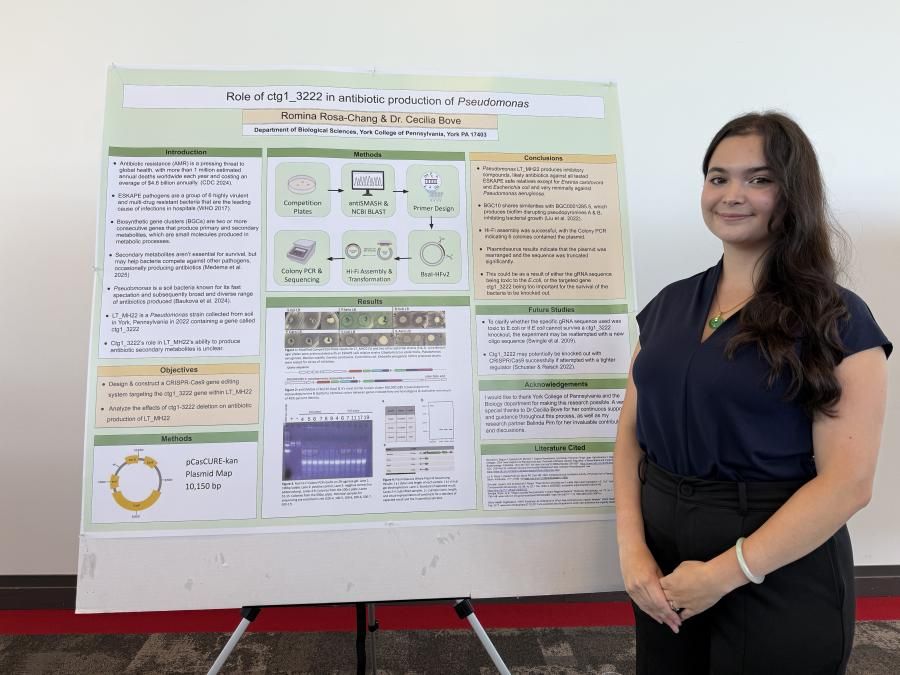
Biology (with Cell & Molecular Concentration) major Romina Rosa-Chang ‘26 found herself interested in the worldwide crisis unfolding and the chance to help address it. So, she and her classmates turned their attention to soil bacteria for their research, focusing on the genes that allow soil microbes to produce antimicrobial compounds.
“My yearlong research investigated a Pseudomonas strain found here at YCP, utilizing bioinformatics and CRISPR in an attempt to find a novel antibiotic,” Romina said. “My goal in this research was to identify if my specific gene, ctg1_3222, played a role in the antibiotic production of our Pseudomonas strain and ideally complete a successful knockout of ctg1_3222 using CRISPR-Cas9.”
The second group studied circular RNA, which are essentially small molecules involved in gene expression in various cancers. By finding ways to properly express circular RNA, the students could gather data on its effects on specific cancer cells, such as cell proliferation.
The group then divided based on whether they wanted to study circular RNA in breast or brain cancer. Some students also looked into its effect on lung cancer.
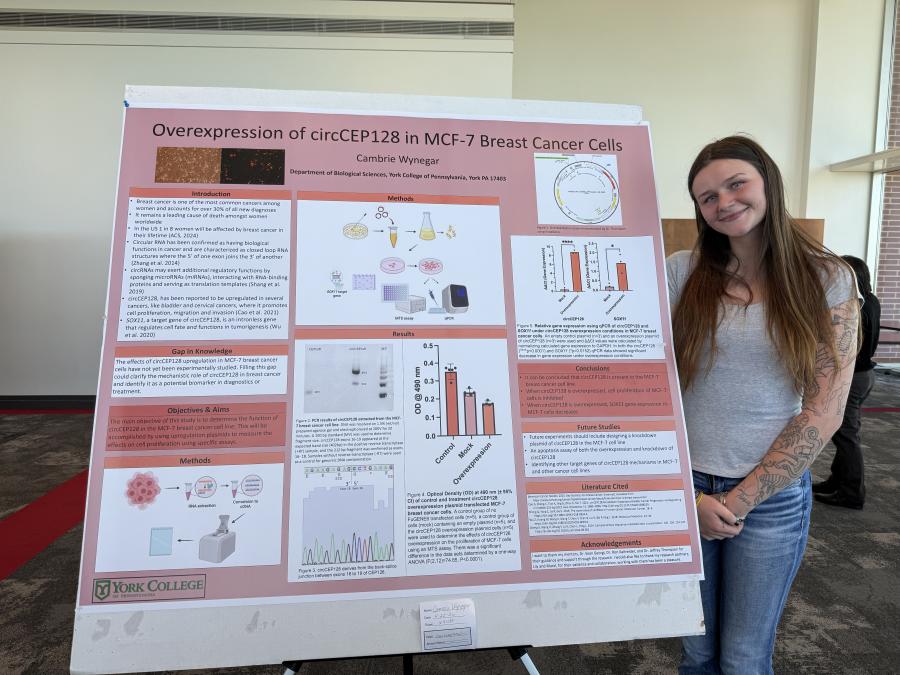
“[...] [We] were able to design a plasmid that overexpressed [the circular RNA], and we were able to collect data on them on what the effects were on those cancer cells,” said Biology major Cambrie Wynegar ‘26. “We…each had our own little circular RNA that we were studying.”
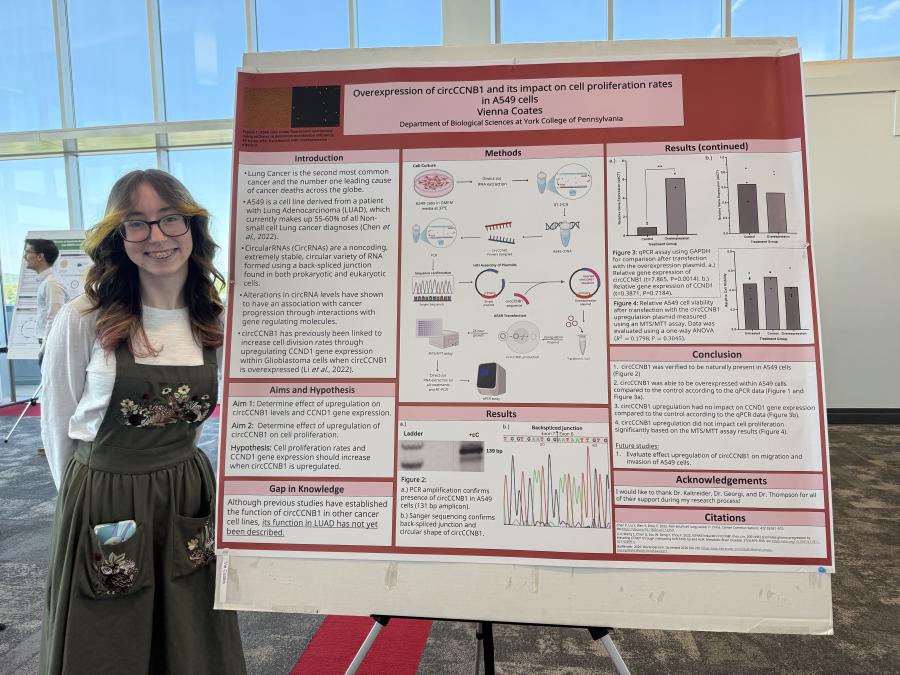
Cambrie’s research focused on the role of circCEP128 in breast cancer. Another student, Vie Coates ‘27, a Premedical Sciences major with a German minor, studied circCCNB1 in a lung cancer cell line.
“I just know that there’s definitely more research that can be made further with my circular RNA,” Vie said. “We weren’t able to find out its particular role in lung cancer, but there are still many more routes we can go with it, and hopefully either I can pick it up further or someone else may find it interesting and keep going with it.”
For the last group, students centered their research on turtles in two local Pennsylvania lakes. Due to the small size of the research group, they were able to conduct extensive in-depth research at the lakes themselves, giving them ample opportunities to study the turtles closely in their natural habitat and collect accurate data throughout the year.
Two Biology majors participated in the turtle research project. Allen Frey ‘26 studied turtles' basking behavior and examined how often they return to the same locations and the contributing environmental factors. Nic Harman ‘26 focused on collecting information on the sizes, ages, and sex ratios of the turtle populations (i.e., the number of males, females, juveniles, and adults in each lake).
“The…study is to understand more about the aquatic turtles overall in the lake,” Allen said. “We…select what we find interesting but still related to the overall overarching question of what is going on with these turtles in the lakes. Turtles are understudied; there’s not a lot known about them. So, we’re just trying to gain some baseline information.”
“We’re also doing it because [one of the lakes being studied] was drained for a certain amount of time to allow its dam to be rebuilt and rehabilitated. And we want to see how the lake being drained and filled back up affected the population of turtles,” said Nic.
The Effect of Structured Research Experience
At the end of the academic year, students created posters displaying their findings and submitted research papers on their topics. They presented the posters to members of the York College community to share what they had discovered after two semesters of hard work and to gain experience presenting research.
They also gain many other skills that they can use in their future career paths. This includes learning how to write cover letters and CVs/resumes, how to apply for jobs in their desired fields, and even how to participate in proper interviews about their background knowledge and experiences. Ultimately, they are taught how to navigate the world of research.
“We hope that this course series will help the students build their scientific identity,” Dr. Nolan said. “The students become active participants in the scientific community, developing hypotheses, designing experiments, and analyzing data to contribute meaningfully to the field. They are sometimes faced with challenges when the experiments don't always proceed as expected, and need to troubleshoot and find a new approach. This process helped them to learn perseverance and build their confidence as scientists.”
Most, if not all, of the students walked away from the experience with accomplished goals. Even if they weren’t able to fully complete their research or look into all the ideas they wanted to address, they established findings and new data that they can pass on to the next cohort of Biology Inquiry students, who can take over and further the progress left off. Depending on what the next cohort completes, they may even be able to officially publish the research, crediting everyone who contributed.
Some students found that the experience has also impacted their views on what their future lines of work will look like. Cambrie, who is going into veterinary school in the upcoming fall, has gained a new perspective on understanding animal biology and how to better care for them.
“I wouldn’t necessarily say that I want to go into animal cancer research, but definitely [I understand] the mechanisms of cancer and how different things play into different gene expression,” Cambrie said. “It’s definitely all useful and pertinent information and something that I’m sure I will be seeing a lot of in my future.”
As for Vie, the year has pivoted toward pursuing a more research-based career instead of medical school. They fell in love with the research they’re doing on lung cancer, and Vie is now looking into personalized oncology research and working in a clinical environment.
“It was a great experience. I have loved every minute of it, even when it’s thrown me for loops,” Vie said. “Research is never linear is a good takeaway. You start one way, and then sometimes, you end up a completely different way. And that’s the beauty of research - you learn to love it.”
Overall, the students grew into competent researchers capable of choosing a topic, exploring it, running an experiment, and analyzing the data they collected to share. Thanks to the support of the Biology Department’s professors, the students are now prepared to take on future research projects and apply the skills they have learned to the real world. They have achieved a great accomplishment, and the faculty and community are excited to see what they do next.
“This class was honestly the most rewarding experience I’ve had throughout college,” Romina said. “It was a fantastic opportunity to not only plan and carry out such in-depth and complex research, but also give me the confidence I needed as an upcoming scientist. It truly exposes you to the many ups and (very) many downs you’ll expect to see in true research, which makes the end so much more fulfilling.”
“We are so proud of all of the students - they did an amazing job!” Dr. Nolan said. “We love to see them develop over the course of the year. When they start in the fall, they are often nervous, and I am sure it feels a little overwhelming. By the end, though, they truly have become experts on their topics, and it is so fun to hear them speak confidently about their research.”