
The Cybersecurity Management graduate recently published his senior research in Homeland Security Today. In it, he shares how the online gaming environment has changed and the potential dangers it poses to younger users.
Online gaming settings are often perceived as spaces where people from around the world can connect and engage in different types of entertainment. Along with this is the notion that they are spaces made for children, designed solely to provide escapism and storytelling narratives that give them a sense of belonging, leading to a lack of monitoring to which most social media and digital platforms are held.
However, as the digital landscape evolves, extremist groups have found ways to create systems of radicalization aimed at targeting younger individuals and encouraging them to step into the darker side of the internet. Without proper monitoring, these systems can encourage cyber crimes and other extremist mentalities that can exist for lasting generations.
This was the topic of Cybersecurity Management graduate Nevin Ferry’s ‘25 senior research, developed in his 2024 CYB 490: Cyber Senior Seminar course. The issue was one he wanted to raise awareness of through his studies, and now he has transformed the research into an article he co-authored with Dr. Tamara Schwartz, Associate Professor of Cybersecurity & Business Administration, published in Homeland Security Today.
The Importance of a Cybersecurity Community
Ferry graduated from York College of Pennsylvania in 2025 with a degree in Cybersecurity Management with a concentration in Operational Security. His love of technology led him to pursue cybersecurity, but compared to other programs, he felt drawn to how York College didn’t just focus on teaching students to master technology, but also on the people behind the systems, teaching management skills, and giving them the acknowledgment they deserved.
But most of all, Ferry wanted to help make the Internet a safer place for people to navigate.
“I’ve always loved playing with technology, especially with video games [and] seeing how computers operate, but also growing up and starting to learn more about not just how computers operate, but how they’re safe,” Ferry said. “So seeing real-world problems that arise behind the concerns of keeping your information safe just helped me gear toward where [I wanted to focus my studies].”
One of his most meaningful experiences was his assistance in founding the York College TechInsight Club. Through it, Ferry helped create a community where students interested in cybersecurity, IT, and homeland security could come together to learn from one another about important topics. It was also a way for students to help build leadership skills and connections as they furthered their expertise in their respective fields.
It allowed Ferry to grow and delve deeper into his research interests, specifically how gaming environments are evolving and contributing to harmful radicalization among younger generations. With the support of the Cybersecurity Management program and his mentor, Dr. Schwartz, Ferry was able to apply his interests to solving real-world problems he sees emerging and present his research findings to the public.
“Understanding online radicalization today requires looking beyond traditional social media platforms and recognizing video games as influential digital communities,” Dr. Schwartz said. “Nevin's research is innovative and important! Not only did he win an award at the 2025 Northeast Decision Sciences Conference, but his work is being shared with the Homeland Security industry, where it can support real-world security.”
Now, he is working as a field technician, which is a step in the direction he wants to go. The opportunity will give him space to learn not just about how technology operates, but the cost of people who use it. It also allowed him to finish his recent research publication and share it with the community.
“One of my goals is to do more community outreach towards that,” Ferry said. “Whether that be reaching through public events or engaging in campaigns that promote similar purposes.”
Recognizing the Dangers of Online Gaming
Ferry’s article, “Digital Playgrounds, Real-World Threats: Radicalization in Gaming Environments,” examines how a seemingly harmless activity in a misunderstood environment can pose a risk. Modern gaming platforms are giving users the freedom to form relationships and build online communities, unaware that some use these new connections to lure vulnerable participants into radicalization.
Extremists often target individuals experiencing isolation and identity uncertainty, using radicalization systems for recruitment. And for a long time, policymakers and parents were unaware of how these strategies were influencing younger generations, unknowingly exposing them to risk.
“Video games are still widely viewed as children's entertainment, but that outdated perception masks their growing role as social platforms,” Dr. Schwartz said. “Physical media made early video games an individual experience. Cloud computing fundamentally changed that model, and gaming evolved into a cloud-based social ecosystem where players collaborate, communicate, and build relationships in real time. This persistent online community has become an attractive environment for extremist recruitment and radicalization.”
Much of Ferry’s research focused on identifying how these systems work and recognizing their invisible impact. It’s a process that creates a loop that is hard to break, but it's possible with proper intervention.
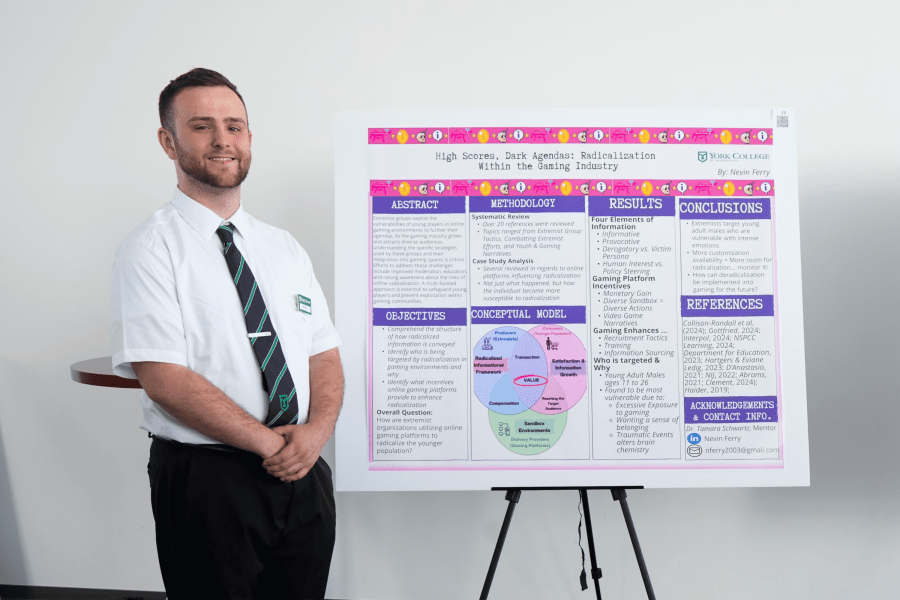
For Ferry, the goal is to bring more awareness of this growing cybersecurity issue and, hopefully, begin a conversation about how to stop the problem from escalating further.
“I grew up playing video games, [and] being in an environment that I enjoyed, I didn’t necessarily understand the dangers behind it growing up until I actually got exposed to the other side of the information,” Ferry said. “So the moment I did get exposed to that information, I wanted to make sure that other generations after me, or just anyone after me, or currently even, are able to also be educated in what I was also exposed to. That way, if people are to have younger individuals exposed to this environment, they are aware and able to enter that digital environment while also being safe.”
Publication Pride
Ferry is excited to have his first research article officially published. He is grateful for the support he has received from the Cybersecurity program at York College, as well as the mentors and classmates he had who became an unexpected family and community that supported him throughout his research process. His family was also a major source of support and encouragement as he pursued his degree and this major achievement.
His time at York College prepared him to share and defend his ideas. And now, he is witnessing the result of all of his hard work and how he is beginning to spread awareness for the issues he has become so passionate about.
“With it being published, I feel as if the work that I put into my research while at York [College] is actually starting to show what dedication and work can get into,” Ferry said.
“Nevin's research highlights a major shift in online radicalization that many security professionals have not yet recognized,” Dr. Schwartz said. “When I shared his findings at the Counterterrorism 2026 Conference in Washington, D.C., many attendees were surprised by how far this shift had progressed. The reaction was especially notable because Nevin's research followed a presentation on countering radicalization on social media by professionals who had not yet recognized that much of the threat had already expanded into gaming platforms."
Ferry is open to expanding on his research or exploring a related topic in the future. But for now, he hopes that the research he spent years crafting will reach professionals in the cybersecurity field who will help him bring meaningful change to address this important issue.
Read Ferry’s article on Homeland Security Today and learn more about how to stay safe while navigating the growing gaming environment.