Faculty Spotlight: Adjunct Prof. Charles (Chip) Kauffman spends Semester teaching at Kufstein University in Austria
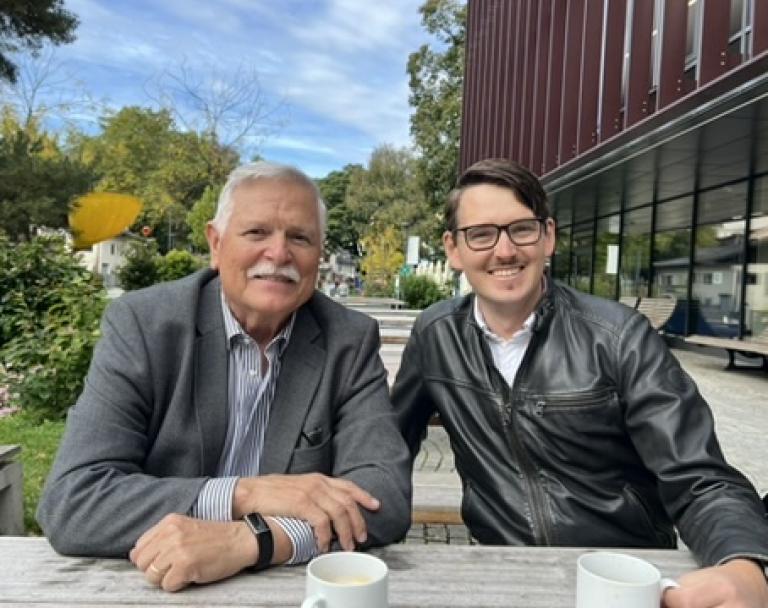
After decades of working in the United States Federal Government and teaching at York College, Adjunct Prof. Charles Kauffman took his diverse language skills to Austria. There, he taught an international language course at FH-Kufstein Tirol, University of Applied Sciences.
When it comes to traveling abroad, York College of Pennsylvania Adjunct Professor of World Languages & International Relations Charles (Chip) Kauffman knows the important role language plays in creating connections. Not only can words reflect history and culture, but they are also our bridge to understanding each other better and connecting as human beings.
Prof. Kauffman has never shied away from any given opportunity to know people around him better, whether they be students or colleagues. As a result, he has dedicated a large portion of his life to learning as many languages as possible and using them in various fields, especially in international relations
“In one way, shape, or another, I worked with about 60 languages, maybe more,” Prof. Kauffman said. “I’m currently studying three languages at my age, and I really enjoy the uniqueness of different languages, especially being able to talk with other people.”
His linguistic knowledge has served him well. From working for the federal government for over three decades to teaching in higher education language departments for close to two decades, Prof. Kauffman’s experience has taken him to many parts of the world.
The latest of which has taken him to Austria, where he spent his 2025 Fall Semester teaching at Kufstein University.
Learning to Love Linguistics
Prof. Kauffman cited that his love of language originated in his childhood. Growing up in Lancaster, Pennsylvania, Prof. Kauffman remembered a time when many Greek families were moving into his neighborhood. Many of the families had children around his age, and wanting to connect and play with them, Prof. Kauffman began learning Greek at an early age. It wasn’t long before he was speaking the language well enough to communicate basically with other children and their families.
His mother also played a role in encouraging him to learn new languages. A teacher who loved music and the arts, she also sang a little opera, which led her to learn some Italian, German, and French, which Prof. Kauffman picked up on.
From there, Prof. Kauffman became determined to learn as many languages as possible. His desire led him to center his education on languages and linguistics, primarily with European languages.
Prof. Kauffman went to Franklin & Marshall College as a high school senior to earn 10 credits in Russian. He then attended Lycoming College, where he played football and received his B.A. in Russian Language, and later the University of Pennsylvania, where he received his Master of Arts in Slavic Linguistics and completed some doctoral work in the field.
By the end of high school, he had learned about four languages. By the end of college, the number had risen to 12. By the end of graduate school, it had reached close to 20-30.
Going Abroad for Government Work
After finishing graduate school, Prof. Kauffman was hired by the United States Federal Government, where he was valued for his ability to apply multiple languages. He traveled abroad frequently, going as far as Central Asia and Europe at times, and also taught part-time as an adjunct professor at the Department of Defense’s language school.
“I was teaching world languages, language recognition, recognition of speech, recognition of written languages,” Prof. Kauffman said. “And in the U.S. government, there are organizations that really need someone to translate or interpret foreign languages. So I spent an entire career, over three decades, working with foreign languages.”
As a result, Prof. Kauffman traveled to over 65 countries during his time working for the government. He also had the opportunity to work with the North Atlantic Treaty Organization (NATO) and its partners, especially in the years following the fall of the Soviet Union.

Prof. Kauffman and his wife, Lori, even lived in England for a short time before moving to Germany, where he worked as Chief of Staff of the European Technical Center. The facility provided equipment and various forms of support to U.S. military operations in war zones. This led him to work with many different countries and use his language skills with them.
Even when he returned from Germany, Prof. Kauffman dedicated his spare time to learning new languages. Commutes by car to Washington, D.C. were spent daily either refreshing his knowledge of languages he had previously studied (including German, Russian, Spanish, and Italian) or learning new ones (such as Navajo, Cherokee, Uzbek, Irish Gaelic, Finnish, and Norwegian).
Joining the York College Team
Prof. Kauffman came into teaching at York College in an unexpected way. When a former York College professor, Dr. Heinz Hosch, suddenly passed away in the early 2000s, the College needed to find someone to continue teaching his Indo-European Languages course. At the time, the class was required as a language for many students during their education there.
In addition to his government work, Prof. Kauffman taught ED courses in the evenings at Penn State York, as well as Italian, German, and Russian. When YCP learned of him from Penn State, they asked him to apply for a teaching position.
Since then, he has been at York College for 20 years and has focused solely on teaching in higher education.
“What I like most about York [College] is the students,” Prof. Kauffman said. “[...] I love sharing my experience. I love sharing my stories. And I really, really like the students.”
After he started teaching Indo-European Languages, Prof. Kauffman developed a continuation course, World Languages, that would cover every continent and its language complexities, writing systems, and unique ways of speaking.
Since then, he’s taught over 120 course sections, 16 distinct courses (including intelligence analysis, languages, and cross-cultural communication), and taught students from all over the world. Some of their home countries include Russia, Ukraine, Belarus, Norway, Israel, Japan, Indonesia, and India. He’s also taught a few students from countries such as Kyrgyzstan through online courses.
A Semester at Kufstein University
One of Prof. Kauffman’s highlights of working at York College has been a recent abroad experience in Austria. During the three months he spent there, he worked as a visiting professor at the FH Kufstein Tirol University of Applied Sciences.
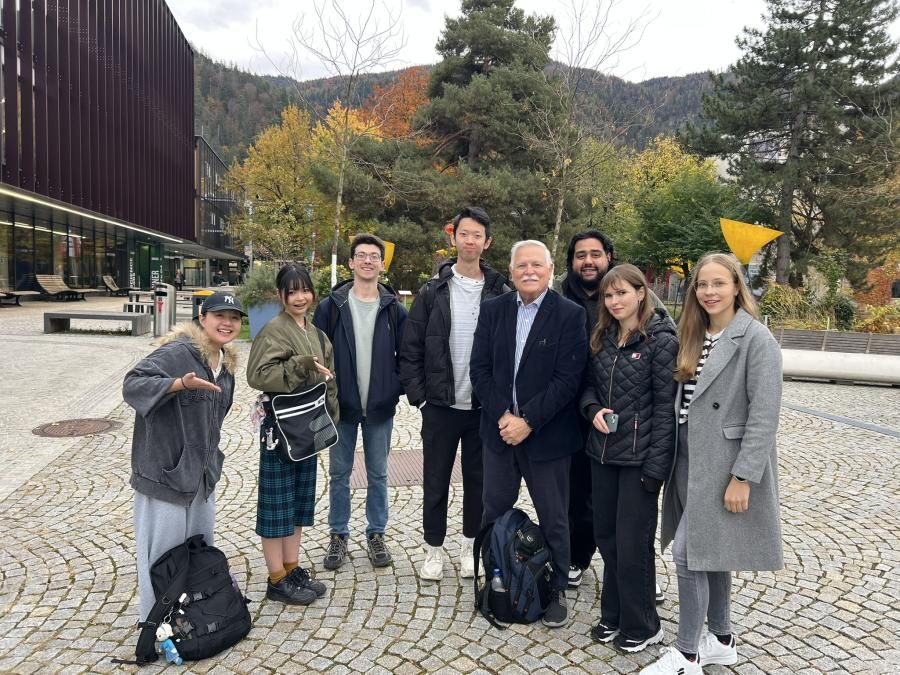
The opportunity arose while talking with some international students from Kufstein, Austria, attending York College. He often touched base with a few international students, and during one of his meetings with them, he was asked if he would consider teaching in Kufstein. When Prof. Kauffman expressed interest, one of the students reached out to Kufstein University’s international program and how the adjunct professor could teach there.
Prof. Kauffman spent his 2025 Fall Semester teaching in Austria, specifically a course he helped create, World Languages for Cross-Cultural Communication for Business, for the university’s international students. Twenty-two students participated in the class, representing five continents and 15 countries, and speaking 18 languages altogether.
“It was just a wonderful experience,” Prof. Kauffman said, bringing back memories of his semester abroad many years ago at the University of Graz, Austria, and Moscow State University, USSR.
Authenticity over Fluency
The experience, as well as many others in which Prof. Kauffman has participated over the years, reaffirmed for him the importance of language. Especially for younger generations, being multilingual can not only be a resource that helps people stand out in job recruitment but also a way to communicate authentically and create real connections.
Technology has made it easier to get immediate translations and communication, but it often lacks a human element. And as its popularity rises, many colleges and universities are dropping foreign language requirements and programs.
“Do you want to develop a relationship with a partner, whether it’s a government partner, a business partner, or even friends?” Prof. Kauffman said. “Do you want to develop a relationship that is based on digital language that gets translated into written language or spoken language? Or do you want to develop a relationship whereby you can speak with each other?”
Prof. Kauffman often heard that people are hesitant to learn or even use foreign languages to communicate because of concerns about their fluency. In his opinion, it doesn’t matter whether or not the language is spoken “perfectly,” but that the speaker is making the effort to learn and understand.
Learning languages builds authentic relationships and can also create healthy brain stimulation. The challenge and reward are something Prof. Kauffman has been familiar with for almost his entire life, and he hopes students don’t miss out on the chance to experience them.
“My career was founded on my ability to communicate with people,” he said. “It wasn’t always perfect, I made mistakes, but my ability to communicate and my willingness, that’s the key point. My willingness to communicate with people who spoke different languages, and not insist on using English, has paid massive dividends.”
As a result, he has many friends around the world.
“When you take the human element out of it, and you take the brain stimulation out of it, it’s a lost opportunity.”
Even now, Prof. Kauffman doesn’t consider himself fluent; he often uses the word earnest because it describes his desire to keep learning and not give up on reaching and connecting with others, regardless of where they are from or how they communicate.
His passion has led him to meet many wonderful people, simply because he spoke a little of another language. Whether they were partnerships on behalf of the U.S. government or students or professors in the classroom, Prof. Kauffman has formed numerous relationships that he still carries with him to this day. And even now, he continues to learn so that he can overcome any limits he may encounter.
“I love languages; it’s my hobby, and it was my career, and it helped me connect with so many people.”