Blueprints for Prosperity – The Role of Trades in Building a Better Life

Careers in Crisis
What jobs are hiring? What is the career outlook for different roles? How can I get an education without going into debt? These are among many of the questions that soon-to-be high school graduates may be pondering as they look towards their futures. These may also represent the questions of individuals looking for a career change, those who have recently lost their jobs, and those seeking employment after time in the justice system. For many, the cost of a four-year education feels insurmountable and individuals are left seeking alternative options. To put it simply, a college degree may be the ideal path for some, but is not the only option and is not necessarily the best option.
Figure 1. Trades Workforce Information Graphic
Exposure to the trades and hands-on industries are thus vital, offering alternative avenues for employment that often come at much lower cost. Associated with the term “blue-collar work,” these roles utilize specialized training in industries such as construction, manufacturing, agriculture, and maintenance. Depending on training, salary and wages can vary significantly, offering significant jumps in pay despite lower upfront costs than would be observed with a traditional 4-year degree. When paired with relevant degrees and additional experience-based training, such as bachelors in business programs or associates in computer aided design programs, these wages can further grow.
The value of these careers is high not just for the individuals pursuing them but also for the communities they live within. Careers in the trades, particularly manufacturing, hold a significant historic value for the City of York, Pennsylvania (PA), an area long known for its prowess in production. Companies such as JohnsonControls, Church and Dwight, Stauffer’s, Hanover Foods, and many more, as described in the image above, have long manufactured their products right here in York County with many employees living or working in the city. Having long been a town built and inspired by the trades, flourishing employment in these areas thus allows for the preservation of not only these companies but also local history, preventing the erasure of what has made York York! Furthermore, such careers, particularly those in construction, are in high demand and low fulfillment according to the Housing Action Plan for the state of Pennsylvania, meaning that a larger labor pool within the construction industry would allow for homes to be built faster (PA Department of Community & Economic Development, 2026). In other words, having more workers to address York’s housing shortage individuals pursuing building trades would expand the availability of safe and affordable housing for residents.

Figure 2. York, Pennsylvania Manufacturing
In summary, the trades offer not only secure employment opportunities to those pursuing them but also have the capacity to improve our communities.
Skillfulness Reaps Benefits
The trades have been a hot topic in recent years due to their typical low barrier to entry, potential for long-term job security amidst growing AI prominence, and anticipated skilled worker shortages due to the aging workforce.
Aging of Workforce
As with many industries, the aging of skilled personnel is a key concern. There are more individuals of retirement age anticipated to leave work in the trades than there are young, trained individuals preparing to enter. Thus, there is anticipated to be a significant gap between the number of open roles and the quantity of skilled professionals to fill them (Liz Sheffield, 2019; Martha Stinson & Sean Wang, 2025). This can contribute to faster callbacks, expedited resume responses, or individualized inquiries depending on the immediacy of need. Many jobs may be looking to hire candidates immediately, making it easier for skilled professionals to secure employment quickly.
Low Barrier to Entry
Many jobs in the trades are known to possess a low barrier to entry, particularly with respect to worker background.
Low barriers to entry can pertain to criminal or legal status. Many roles, such as those in landscape maintenance and manufacturing, often express willingness to hire reentrants, or individuals leaving the prison system. This can offer a second chance in a workforce that often rejects the employment of such individuals.
Despite these low barriers to initial hiring, keeping a role is still dependent on skill. To frame this in another lens, it can be easy to secure a job, but you need to continuously prove your worth to keep your position.Though all roles require competency, this often stands in sharp comparison to white-collar roles where the initial hiring process may be significantly challenging with hundreds of applicants but the post-hiring process may result in extended tenure. Many businesses may participate in temporary staffing, such as through companies like Manpower, and work-day interviews can be quite common. These processes allow potential hires to gain days to weeks’ worth of paid training while they are learning the responsibilities of a role. However, applicants may be asked not to return if their skillsets and attitude appear to mismatch with role expectations. This practice uniquely allows companies to gauge hands-on capabilities before hiring staff on, giving them room beyond a resume to understand new workers. Thus, understanding the expectations of a job and showcasing prowess are key to preserving one’s viability. Furthermore, some roles in industries such as transportation or defense contracting require staff to follow state or federal regulations pertaining to substance usage. Standards here such as randomized drug testing may present challenges for those in addiction recovery or with prior related convictions, further complicating job availability and long-term security despite this initial low barrier to entry.
Long-term Security
It is worth noting that artificial intelligence (AI) prominence has begun to uproot expectations of what secure jobs or guaranteed job prospects mean. Careers in software development and finance appear to be shaken up as the capacity for AI replacement grows (Atul Kumar, 2025). Although the trades do not represent a fool-proof career path, as no role does, Anthropic, an AI company centered on research and development, shared that there is a lower anticipated impact from AI with many hands-on roles. Examining user data gathered through use of their own AI platform Claude, they were able to develop theoretical impacts on industry. According to the figure below, found in Anthropic’s March of 2026 report entitled Labor market impacts of AI, the occupations anticipated to be most impacted include those such as business and finance, management, and engineering, while those anticipated to be least impacted include grounds maintenance, transportation, production, construction, and installation and repair work (Maxim Massenkoff & Peter McCrory, 2026).
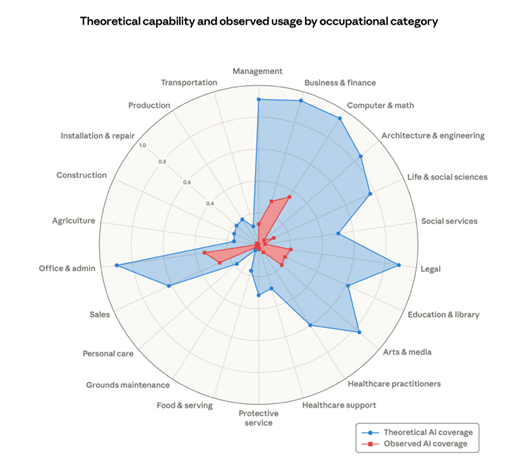
Figure 3. Theoretical and Observed AI Usage by Occupational Category
Although this report offers no guarantees and exhibits bias having been prepared by developers of the Claude model, it does present some food-for-thought pertaining to the long-term job security of different career paths.
Another approach to analyzing AI-specific job vulnerability used by GovAI and Brookings Institution suggested similar conclusions, stating that many positions in the trades, such as construction workers and plumbers, experience low exposure to AI and are moderately adaptable to its impacts (Schaul & Ovide, 2026). Once again, this report should be considered food-for-thought but cannot be considered a guarantee of job security.
Building a Better Future
No matter how valuable or profitable a career prospect may seem, however, reaching one’s goals can be a substantial challenge without access to proper training. While some careers within the trades may require little training in advance of starting a job, many others mandate long-term expertise, licensing, or certifications in order to keep a position or obtain roles at higher pay levels. Formal training for these types of jobs can exist at community colleges, 4-year colleges, trade schools, apprenticeship programs, on-the-job employee development programs, and more. For instance, York College Gunter-Smith Center for Community Engagement is presently sponsoring lead abatement training at their facility in Downtown York. Although this type of training is often supplementary, it can significantly expand job opportunities. Individuals of varying age ranges can also access trades-oriented programming or camps through companies such as MANTEC, a York-based organization, that focuses on accessibility and efficiency of training within the manufacturing industry. Necessary skillsets will inevitably vary by profession, but some prominent hard skills that may be broadly required include geometric dimensioning and tolerancing, the ability to read and decipher blue prints, experience with hand tools, and OSHA training. Soft skills, however, are also considered to be exponentially valuable to the trades. Business Advisor at MANTEC Cindi Moses suggested during a recent conversation that the COVID-19 pandemic depleted communication skills, resulting in poor problem solving and critical thinking that unfortunately disproportionately impacts many young professionals entering the work force. She stressed the importance of developing these less emphasized skills, mentioning that no matter how many technical talents an individual possesses, they will struggle if they do not understand how to work with others.
Opportunities like job shadowing and factory tours provide opportunities to learn about the wide ranges of career opportunities available. For the sake of this article, however, availability of education for trades within the building industry will be discussed as opposed to all skilled labor professions. As mentioned, positions within the building industry are a key area of both concern and opportunity within York, PA with their absence directly correlating to decreased accessibility of housing. Paired with labor shortages, including the retirement of 41% of existing workers within construction by 2031 (Liz Sheffield, 2019), and aging quality of housing stock resulting in possible lead paint exposure, those pursuing careers within these trades are community assets in their expansion and preservation of the housing stock (PA Department of Community & Economic Development, 2026). There are 24 sponsored and active apprenticeship programs in the building trades within York County as of April 2026. According to data procured from the Apprenticeship and Training Office within the Pennsylvania Department of Labor & Industry, the largest percentage of apprentices in the building trades within York County held the job titles of electricians (35.32%) or carpenters (19.24%). Companies sponsoring these apprenticeship programs included those such as Kinsley Construction Inc., The Yorkaire Group, the Manufacturer’s Association of South Central PA, and the York Electrical Institute amongst others. The area is also fortunate to have access to York Tech which offers training in the construction trades, carpentry, electrical work, HVAC, and more for high school students in grades 9-12, providing valuable education for those looking to get their careers started early.
Taking Chances
Deciding what path to take in life is not a light choice, but it is never solved with a one-size-fits-all approach. For some, their path may include the traditional 4-year degree. For others, it may include on-the job training, toiling with nature in the hot sun or working beside large, whirring machinery, blueprints spread across tables. Apprenticeship programs, just like a college degree, can help York’s residents accomplish their dreams and secure the life they desire.

Hannah Zinn is York College of Pennsylvania’s Urban Collaborative Scholar-in-Residence. Her research has primarily focused on urban greenspace and housing, but she is also engaged with the facilitation of local gardening initiatives through her role. Hannah can be connected with on LinkedIn.
References
Atul Kumar. (2025, August 12). Why AI is replacing some jobs faster than others. World Economic Forum. https://www.weforum.org/stories/2025/08/ai-jobs-replacement-data-careers/
Liz Sheffield. (2019, February 11). Construction Grows, But Baby Boomers Retiring Leaves Gap | SPARK Blog | ADP. SPARK - ADP. https://www.adp.com/spark/articles/2019/02/construction-grows-but-baby-boomers-retiring-leaves-gap.aspx
Martha Stinson & Sean Wang. (2025, December 2). Firms in Production Sectors and Northern States Have Some of the Highest Shares of Older Workers. Census.Gov. https://www.census.gov/library/stories/2025/12/older-workers.html
Maxim Massenkoff & Peter McCrory. (2026). Labor market impacts of AI: A new measure and early evidence. https://cdn.sanity.io/files/4zrzovbb/website/2b5bbaf2c1eb81dbf6e6fb813c1a24e35a64d376.pdf
PA Department of Community & Economic Development. (2026). Housing Action Plan. Commonwealth of Pennsylvania.
Schaul, K., & Ovide, S. (2026, March 16). See which jobs are most threatened by AI and who may be able to adapt. The Washington Post. https://www.washingtonpost.com/technology/interactive/2026/jobs-most-affected-ai-automation/
Appendix
Green infographic stating that skilled trades employ people from a wide range of backgrounds and life circumstances. Large black text reads, “The trades employ individuals from all walks of life, such as reentrants, high school graduates, and those in career changes.” On the left side, black line-art icons of a wrench and screwdriver represent trade occupations.
Infographic titled “York, PA Manufacturing” highlighting four examples of products associated with manufacturers in the York, Pennsylvania, area. The graphic is outlined in green and displays four company names with representative product images.
Johnson Controls is represented by a YORK-brand outdoor air-conditioning unit. Church & Dwight is represented by a bottle of Arm & Hammer OxiClean laundry detergent. Stauffer’s/Meiji is represented by boxes of Stauffer’s Animal Crackers and Meiji Hello Panda chocolate-filled cookies. Hanover is represented by a bag of Hanover mixed vegetables.
Source links shown beneath the images:
Johnson Controls/YORK product image: https://freemanairheat.com/hvac-product/york-yc2f-air-conditioner/
Church & Dwight/Arm & Hammer product image: https://www.armandhammer.com/en/laundry
Stauffer’s/Meiji product image: https://meijiamerica.com/
Hanover product image: https://hanoverfoods.com/product/hanover_mixed_vegetables/
Radar chart titled “Theoretical capability and observed usage by occupational category.” The chart compares theoretical AI coverage, shown in blue, with observed AI coverage, shown in red, across a range of occupational groups.
The blue theoretical-coverage area is substantially larger than the red observed-coverage area for most occupations, indicating that AI could theoretically be used for more tasks than current usage reflects. Theoretical coverage is especially high in categories such as management, business and finance, computer and math, architecture and engineering, life and social sciences, legal occupations, education and library, arts and media, and office and administrative support.
Observed AI coverage remains comparatively low across nearly all categories. It is most noticeable in management and business and finance, with smaller levels appearing in areas such as computer and math, legal, office and administrative support, and sales. Occupations involving more physical or hands-on work—including agriculture, construction, installation and repair, production, transportation, food service, and grounds maintenance—show relatively low theoretical and observed AI coverage.
A legend identifies blue as “Theoretical AI coverage” and red as “Observed AI coverage.”